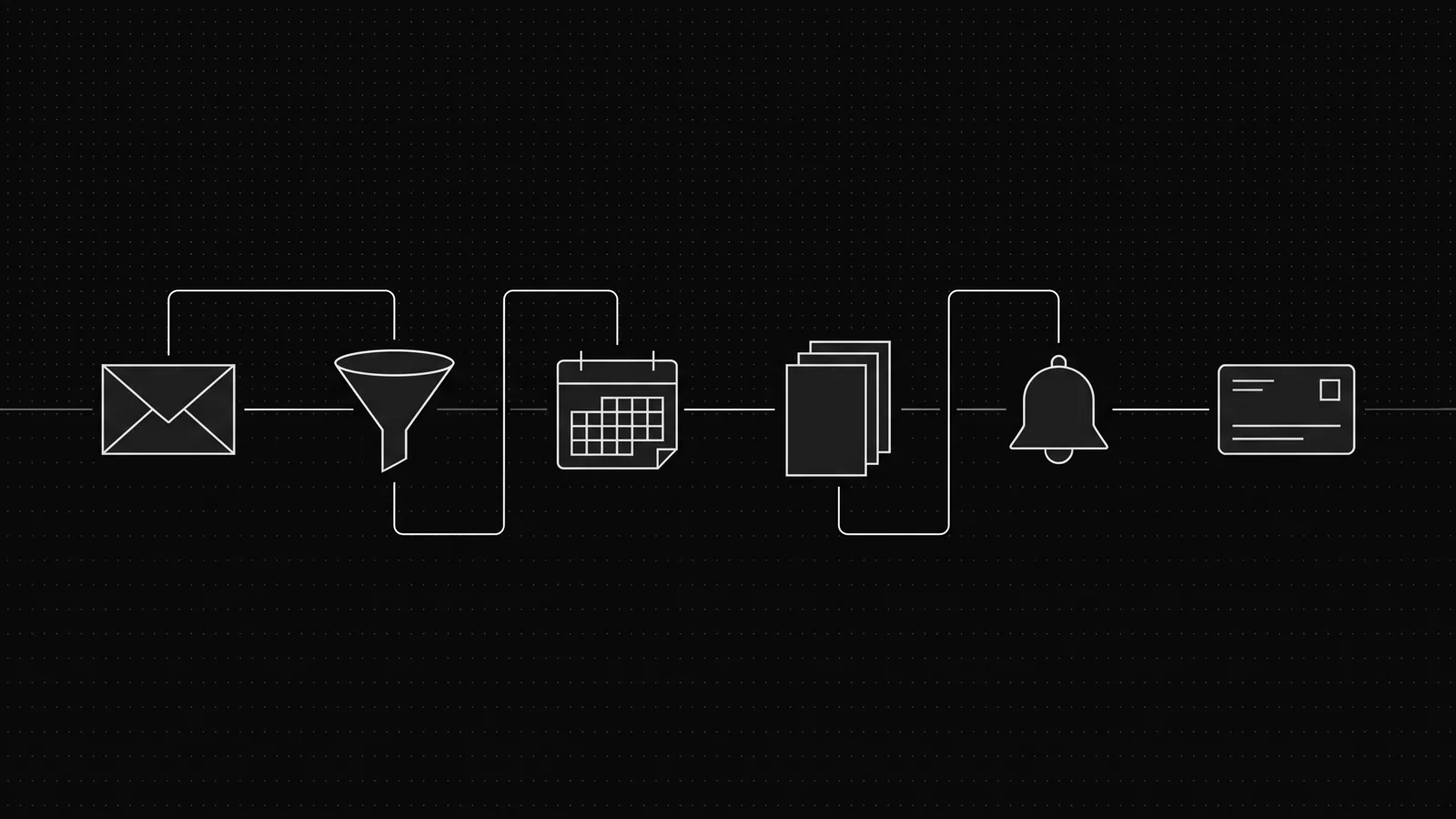
End-to-end automation for a UAE service business means joining intake, qualification, scheduling, document handling, status updates and invoicing into one pipeline, not replacing all of it. The sequence matters more than the tooling: automate intake and documents first because they are measurable, keep quoting and complaints with people, and invoice last once the data feeding it is clean
This is the pipeline we design for Dubai service teams, ordered so each step funds the next
What parts of a service business can be automated end to end?
Five stages carry most of the workload, and each has a clear automation verdict. Intake, scheduling and status updates are safe to automate early. Qualification is automatable up to a confidence threshold, then a person takes over. Document handling splits: extraction automates well, final review does not. Invoicing automates cleanly only once the workflow data behind it is reliable
The stages in order, as they appear in a real enquiry:
- Intake: capture the enquiry wherever it arrives and turn it into a structured record
- Qualification: decide whether this enquiry can become a job
- Scheduling: agree the appointment or site visit
- Documents: collect, extract and validate anything the job needs
- Status update: keep the customer informed as the job progresses
- Invoice: bill once delivery is confirmed
Nobody should build all six at once. The order below is the sequencing that avoids paying for work the team will not use
Where do you start automating a service business?
Start at the step you can measure in weeks, which is almost always intake or document re-typing. Log response time on new enquiries, or count hours staff spend copying fields from chats and PDFs into a spreadsheet. Automate that one step, record the before and after, then extend to the next link
The reason to start with intake is that it compounds. A faster first reply raises the share of enquiries that become jobs at all, which makes every later automation worth more. On our a property-management platform property management build, the MVP shipped in 10 days and the AI currently handles about 60% of tenant chats, with the rest handed to a person (a property-management platform). The intake layer was the part that paid for the rest
A common mistake is buying the full system first. Most expensive UAE failures come from paying for every stage up front and finding out in month four that the team only uses two of them
The end-to-end pipeline, with an automation verdict per stage
This is the artifact we put in front of clients. Each stage has a verdict: automate now, automate with a human gate, or keep with a person. The sequence reads top to bottom as an enquiry becomes a paid job
| Stage | What it does | Automation verdict | Where a person stays |
|---|---|---|---|
| Intake | Capture the enquiry from WhatsApp, web form, email or call and create a structured record | Automate now | Review the first dozen records so the mapping is right |
| Qualification | Determine budget, scope, timeline and whether this is a real job | Automate up to a confidence threshold | Above the threshold, route the full thread to a named person |
| Scheduling | Offer available slots, confirm the visit, send reminders | Automate now | Exceptions and last-minute reschedules go to a calendar owner |
| Document handling | Collect files, extract fields, validate against records | Automate extraction and validation | A person approves every low-confidence extraction and anything external |
| Status update | Tell the customer where the job is and what happens next | Automate now | Escalations and complaints leave the automated loop |
| Invoicing | Generate the bill from confirmed work and payment terms | Automate last | Approve the invoice before it is sent in the first months |
Two rules govern the whole pipeline. Rule one: automate the stages that move information, keep the stages that move judgement. Rule two: each automated stage must flow its output into the next automatically, or you have merely bought a series of disconnected tools
What does document handling look like in the pipeline?
Document handling is usually the stage where a service business loses the most time, and where AI earns its place by extracting fields a person re-types by hand. The pipeline reads whatever document applies to the job, pulls the fields you care about, and checks them against each other and against your records
The verification matters more than the AI part. A pipeline that extracts 30 fields with no checks feeds wrong data into your CRM at machine speed. We cover the field maps and review queues for property documents in our Ejari, SPA and NOC pipeline write-up, but the pattern is the same for a visit report, a maintenance log or a service certificate
On our UAE Visa Platform, passport scans go through OCR and extraction before an application is filed, and processing time dropped from several days to between a few hours and 2 days. The extraction was one piece; the same rule applies: extract automatically, but keep a person on the low-confidence queue
Where do humans stay in the pipeline?
People stay on the stages where being wrong is expensive: quoting custom jobs, resolving complaints, and approving anything that goes outside the business. The automation does not remove these people. It removes the re-typing and chasing that currently eats their day, which lets the same headcount handle more jobs
The handoff rule is the same one we use for WhatsApp bots. A qualified enquiry above the confidence threshold routes to a person with the full conversation, the bot's classification and the reason for escalation, so the customer never repeats themselves (human handoff on WhatsApp). The same principle applies at every other gate in the pipeline
The teams that succeed give the machine the information-moving stages and keep a named person on the judgement gates. When we time them, the same headcount handles roughly double the jobs after the pipeline ships, not fewer roles.
How much does end-to-end automation cost for a Dubai SME?
A full enquiry-to-invoice pipeline runs mid five figures to low six figures AED depending on the integrations. The honest split is sequenced, not all-or-nothing. Intake plus scheduling is a first workflow at the small-build end, roughly 15,000 to 40,000 AED (how much AI automation costs in Dubai). Adding document handling pushes it into pipeline territory, 40,000 to 120,000 AED. Invoicing last adds the least, because it reuses the work data already flowing through the stages, but it is the stage teams should not bill until the pipeline feeding it is steady
The running costs are separate and small relative to the build: model API spend, hosting, and a maintenance retainer of 10 to 20% of the build per year to keep templates, rules and integrations current. None of these is a reason to delay the first stage
Does automation replace staff in a UAE service business?
In practice it shifts roles rather than removing them. The people doing intake and re-typing move to client-facing and exception work, because the machine handles the volume and the business grows into the freed capacity. The same people matter more, not less: they become the approval gate the rest of the pipeline depends on
The legal framing matters too. Chat records, contact names and phone numbers moving through the pipeline are personal data under the UAE Personal Data Protection Law (Federal Decree-Law No. 45 of 2021). Whoever designs the pipeline should document where each data point flows, which subprocessors see it, and how deletion works, because those obligations sit with you as controller. We cover the data-flow side in PDPL-compliant AI CRM in the UAE.
Watch out
How do you sequence the rollout so each step funds the next?
The rollout order mirrors the pipeline itself. Start with intake because it is measurable in weeks and compounds. Add scheduling and status updates next, since they reuse the same structured record. Bring in documents when the intake volume justifies it. Invoice last, once the data feeding it is clean enough that a generated bill is trusted
Each stage has an acceptance test before you extend. For intake, response time on new enquiries. For qualification, the share of enquiries that become jobs. For documents, the share of fields extracted without correction. Extend only when the prior stage holds its number, and keep a person on every judgement gate
If you want a fixed number for your own pipeline, book the free audit and we will map your current workflow, flag the bottleneck, and tell you which stage to automate first and what it should cost
The takeaway
An end-to-end pipeline joins six stages, and the sequencing matters more than the tools: intake first, documents second, invoicing last. Automate the information-moving stages, keep a person on the judgement gates, and prove payback on each stage before extending to the next. The same team then handles roughly double the jobs without doubling headcount
Book the free audit and we will map one workflow and give you the ordered automation plan for it
FAQ
What parts of a service business can be automated end to end?
Intake and qualification, scheduling, document collection, status updates and invoicing. Judgment work — quoting custom jobs, complaints, exceptions — stays with people
Where do you start automating a service business?
At the bottleneck you can measure: usually lead response time or document re-typing. Automate that one step first, prove payback, then extend to the next link
How much does end-to-end automation cost for a Dubai SME?
Full pipelines run mid five to low six figures AED depending on integrations. Most teams sequence it: intake first, documents second, invoicing last
Does automation mean replacing staff?
In UAE service SMEs it usually means the same team handling more volume — the people doing intake and re-typing move to client-facing and exception work
Sources
- Federal Decree-Law No. 45 of 2021uaelegislation.gov.ae