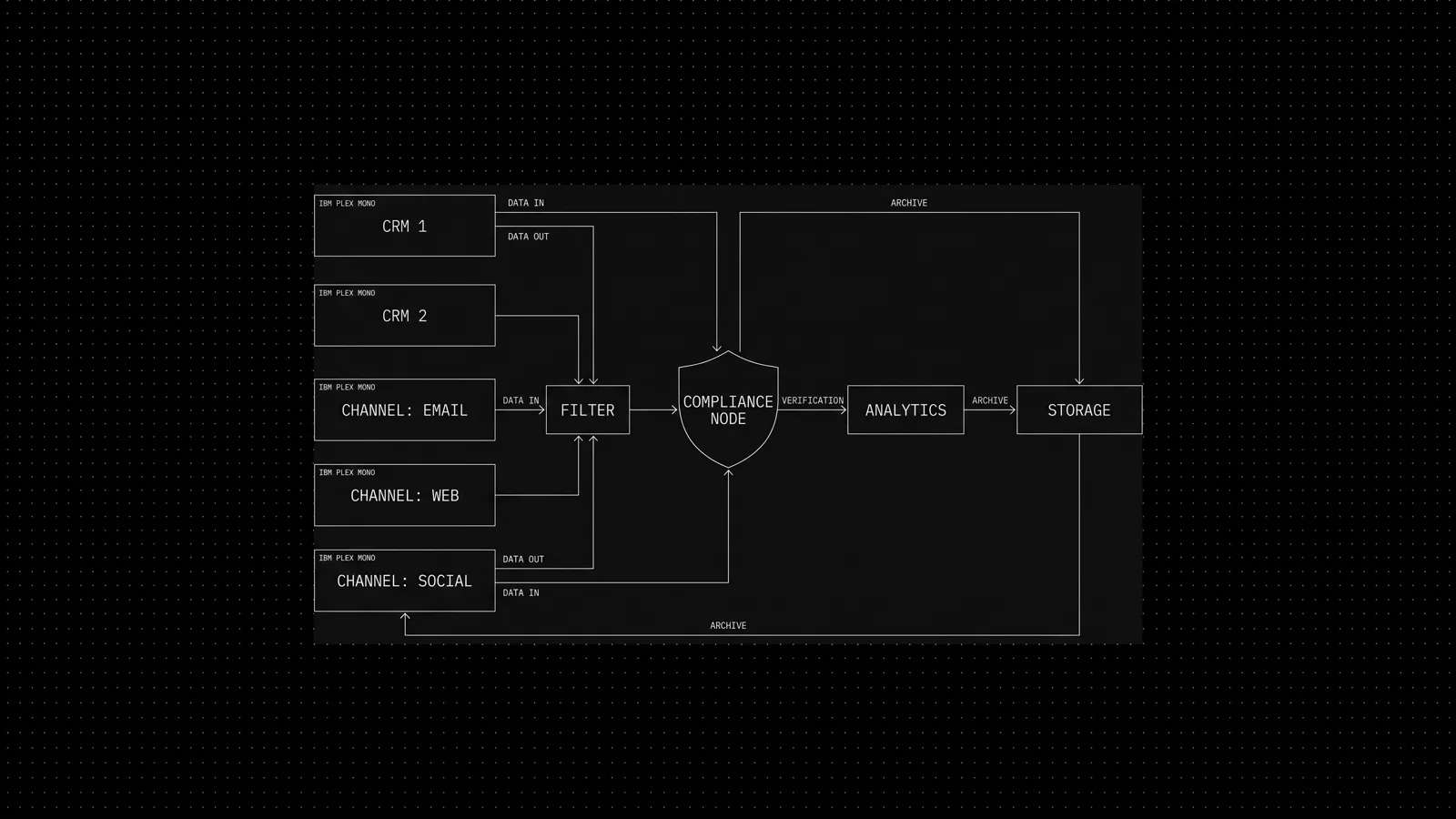
An AI CRM passes a PDPL audit when you can show, hop by hop, where personal data goes: which processor touches it, in which country, for how long, and under which lawful basis of Federal Decree-Law 45/2021. That means a written data-flow map, a processing record, a deletion path that reaches backups, and a human-review path for automated decisions the data subject objects to
We are engineers, not lawyers. This post describes how we design and document systems so your counsel and your auditor have something concrete to check. It quotes the Decree-Law directly and does not replace legal advice
What does PDPL actually require of an AI CRM?
The UAE Personal Data Protection Law, Federal Decree-Law No. 45 of 2021, has been in force since 2 January 2022. For a CRM that ingests WhatsApp chats, portal leads and documents, five of its articles turn into engineering work.
| Article | What it says, paraphrased | What it means in the system |
|---|---|---|
| Art. 4 | Processing needs consent unless an exception applies, such as performing a contract the data subject asked for (Art. 4(9)) | Every record carries a lawful_basis field set at intake |
| Art. 5 | Collect for a specific purpose, keep only what is necessary, delete when the purpose is exhausted | Field-level minimisation and a retention timer per data class |
| Art. 6 | You must be able to prove consent, and withdrawal must be easy | Consent is an event row with timestamp, channel and wording version |
| Art. 7(4) | The controller keeps a record of processing: categories, who has access, erasure mechanism, cross-border movement, security measures | A processing register generated from the same config the code reads |
| Art. 22-23 | Transfers outside the UAE need an adequate jurisdiction, a protective contract, explicit consent, or contractual necessity | Every LLM, OCR and storage vendor outside the UAE is a documented transfer |
Two more articles bite hardest on AI features. Article 18 gives the data subject the right to object to decisions made by automated processing, and Article 18(4) requires a human to review such decisions on request. Article 15 gives a right to erasure, with exceptions where other laws require you to keep the record
Scope matters too. Article 2(2) excludes, among others, government data, health and banking data covered by their own legislation, and establishments in free zones that have their own data protection laws. A brokerage established in DIFC or ADGM is outside the federal PDPL and answers to that zone's regime. A mainland Dubai brokerage with a RERA-registered office answers to the federal law
Several details, including breach-notification timelines, the DPO volume threshold and transfer controls, are deferred to Executive Regulations (Art. 28) — still pending as of late 2026. Check their current status on uaelegislation.gov.ae before you trust any vendor who quotes you a specific number of hours. Note too that in June 2026 the federal government announced the Artificial Intelligence and Data Authority, which consolidates the Data Office's remit; it does not change the law's text, but it is where the regulator signals will come from.
Where does your data actually flow?
In a typical WhatsApp plus CRM plus retrieval stack, personal data crosses six or seven boundaries before an agent reads it, and at least two of them usually sit outside the UAE. We draw this map in the first week of a build, before any model is connected
Lead (UAE resident)
  |
  | 1. WhatsApp message / Property Finder or Bayut enquiry / web form
  v
[Channel processor]  Meta Cloud API, portal lead feed
  |
  | 2. webhook (TLS)
  v
[Inbox service]  your server, documented region
  |-- 3a. redacted prompt ------> [LLM provider]  cross-border
  |-- 3b. document image -------> [OCR service]  self-hosted or vendor
  |
  | 4. structured fields + lawful_basis + consent_id
  v
[CRM]  HubSpot / Zoho / Odoo / Salesforce / custom Postgres
  |
  | 5. files, embeddings, backups
  v
[Storage]  object store, vector index, encrypted backups
  |
  | 6. role-scoped views
  v
[Humans]  agents, team leads, back office; every read is logged
The table annotates each hop with the facts an auditor will ask for. The vendor names are examples of what sits at each position; your map lists your actual vendors
| Hop | Personal data | Processor (example) | Location | Retention | PDPL basis to document |
|---|---|---|---|---|---|
| 1. Channel | Phone number, name, message text, voice notes | Meta (WhatsApp Cloud API) | Meta data centres | Up to 30 days for messages, per Meta's Cloud API data privacy page | Consent at opt-in, or Art. 4(9) when the lead asked to be contacted |
| 1. Portal lead | Name, phone, email, listing reference | Property Finder, Bayut, Dubizzle feeds | Portal's systems | Portal's own policy | Lead submitted the enquiry; record the source |
| 2. Inbox | Full conversation, media | Your app server | Region you choose and write down | Conversation log: e.g. 24 months, then anonymise | Same as hop 1 |
| 3a. LLM | Message text with phone, Emirates ID number and email masked | OpenAI, Anthropic, Google | Usually outside UAE | Per vendor API terms; turn on zero-retention options where offered | Art. 23 transfer: contract terms plus notice to the lead |
| 3b. OCR | Passport, Emirates ID, Ejari, SPA, title deed images | Self-hosted OCR, or a vendor | Your region if self-hosted | Image deleted after extraction unless a deal file needs it | Art. 4(9) contract performance |
| 4. CRM | Contact, budget, preferences, deal stage | CRM vendor | Vendor's region | Life of the client relationship plus legal hold | Contract or consent, stored per record |
| 5. Storage | Documents, embeddings, backups | Object storage, vector DB | Documented region | Backups rotate on a fixed cycle, e.g. 35 days | Art. 20 security measures: encryption at rest |
| 6. Humans | Whatever their role allows | Your staff | Office and remote | Access log kept 12 months | Art. 7(4) record of who can access |
The retention numbers in the Inbox, Storage and Humans rows are defaults we propose; you set yours with counsel. The one value an auditor must never see is "unknown"
Meta describes itself as a data processor for Cloud API and keeps messages for a maximum of 30 days to support retransmission. So one WhatsApp conversation exists in at least three places (Meta, your inbox, your CRM), and each copy needs its own row
Which data needs extra protection?
Emirates ID copies, passport scans and anything that reveals religion, health or family status need tighter handling than a phone number. Article 1 defines Sensitive Personal Data to include religious beliefs, family details, health and biometric data. A scanned passport carries a photo and an ID number. If you run face matching on it, the output is biometric data
Dubai real estate deal files collect these by default. An SPA names the buyer and their passport number, an Ejari tenancy record carries the tenant's Emirates ID, and a developer NOC application may include both parties' documents. Our Ejari, SPA and NOC pipeline post covers extraction. For compliance, the image lives in one encrypted bucket with a short retention timer, and only the extracted fields the workflow needs travel downstream
Identity documents arrive on the first screen of some products. Our UAE Visa Platform starts every application with a passport scan, which is why GovTech builds force these storage decisions early instead of after launch
What does a redacted record lifecycle look like?
A lifecycle table answers the deletion question before anyone asks it. For each data class you write down where it lives, how long it stays, and the code path that removes it. Here is a redacted template for a real estate CRM
| Data class | Primary storage | Copies | Retention trigger | Deletion path | Logged as |
|---|---|---|---|---|---|
| Lead contact (name, phone, email) | CRM contact | Inbox, Meta (30 days) | No reply in 12 months, or erasure request | CRM delete job anonymises contact, inbox thread purged | erasure.contact |
| Chat transcript | Inbox DB | Meta (30 days), LLM vendor per terms | 24 months after last message | Nightly job replaces text with a hash and keeps metadata | retention.chat |
| Emirates ID / passport image | Encrypted bucket | None by design | Deal closed plus legal hold period | Object lifecycle rule, then bucket audit | retention.id_doc |
| Extracted ID fields | CRM deal record | Backups | Same as deal record | Deleted with the deal record; backups age out | erasure.deal |
| Ejari / SPA / NOC PDF | Deal folder | Backups | Legal hold period set by counsel | Folder delete plus backup rotation | retention.deal_doc |
| Embeddings of documents | Vector index | None | Source document deleted | Delete by source_id, then reindex | erasure.vector |
| Consent events | Consent table | Backups | Kept as proof for the life of the relationship | Removed last, after all dependent data | consent.closed |
The vector index row is the one most teams miss. If a contract was chunked and embedded for retrieval, deleting the PDF leaves its text recoverable from the index. Every chunk needs a source_id so one call removes it
Backups are the other gap. You cannot surgically edit an encrypted backup, so the accurate answer to "is it deleted?" is "it is deleted from live systems now and ages out of backups within 35 days." Write that sentence in your privacy notice and your processing record
What does an auditor ask for?
An auditor asks for evidence: the processing record, the transfer list, consent proof for a sample of records, and a demonstrated deletion. This is the checklist we prepare before a client's review
| The auditor asks | What you show | Article |
|---|---|---|
| What personal data do you process and why? | Processing register, one row per data class, with purpose | Art. 5, 7(4) |
| Who has access? | Role matrix exported from the app, plus access logs | Art. 7(4) |
| Which vendors process data for you? | Processor list with contract, location, retention | Art. 7(5), 8 |
| Does any data leave the UAE? | Transfer list: vendor, country, mechanism under Art. 22 or 23 | Art. 22-23 |
| Prove this person consented | Consent event: timestamp, channel, wording version, withdrawal status | Art. 6 |
| Show me an erasure request handled end to end | Request ticket, deletion job output, log entries per system | Art. 15 |
| Can a customer contest an AI decision? | Approval queue and the named reviewer for each decision type | Art. 18 |
| How is data secured? | Encryption at rest and in transit, key ownership, restore test results | Art. 20 |
| Did you assess the AI processing before launch? | Impact assessment covering profiling and sensitive data volume | Art. 21 |
| What happens in a breach? | Runbook: who detects, who notifies, which systems are isolated | Art. 9 |
If the register is a spreadsheet maintained by hand, it drifts from the code within a quarter. We generate it from the same retention and vendor config the deletion jobs read, so the document and the system cannot disagree
Which CRM changes make a system compliant?
You do not need a new CRM. HubSpot, Zoho, Odoo or Salesforce all work, because PDPL governs how data moves between systems rather than which product holds it. The changes go in four places
- Add schema fields. Each contact and deal gets
lawful_basis,consent_id,source_channelandretention_class. Intake refuses to create a record without them - Mask before the model. Phone numbers, Emirates ID numbers, passport numbers and emails get replaced with tokens before text goes to an LLM, and re-inserted on the way back. The model gets the context it needs to qualify a lead without the identifiers
- Put humans in front of consequential actions. We use approval queues for low-confidence classifications, high-value lead routing and any outbound message that commits to price or availability. On our 8,000-unit inventory CRM the AI assistant proposes status changes and a person approves them; the system took status accuracy from about 60% to about 98%
- Build erasure as one command. A job walks CRM, inbox, vector index and object storage by subject ID and writes a log line per system
Human review still leaves room for heavy automation: on a property-management platform, about 60% of tenant chats are handled by AI. Pick the ratio by risk and write it into the processing record
On the a property-management platform build, about 60% of tenant chats are handled by AI before a person steps in. We choose that ratio by risk, and we write it into the processing record so an auditor can see the human stays in front of the consequential actions.
Two decisions belong to you and your counsel: the retention periods, and whether marketing messages rely on consent. Meta's Business Messaging Policy separately requires opt-in before you message someone on WhatsApp; our WhatsApp Business API guide covers opt-in flows and templates.
When comparing vendors, ask each one for a filled-in hop table from a past project. That question is on our list for choosing an AI automation agency in Dubai, and the AI real estate systems page shows how we scope these builds
The takeaway
PDPL compliance for an AI CRM comes down to documents that match the code: a hop-by-hop data-flow map, a processing register, a lifecycle table with real deletion paths, and approval queues where automated decisions affect people. Draw the map before you connect the LLM, and an audit becomes a review of evidence you already have
Book a free audit and we will map your current lead and document flows against Federal Decree-Law 45/2021 and show you which hops are undocumented
FAQ
Is AI automation in the UAE PDPL compliant?
Compliance comes from the architecture: a documented data-flow map, named subprocessors, retention and deletion paths, and a lawful basis per Federal Decree-Law 45/2021
Where is customer and Emirates ID data stored?
In a compliant build, primary storage sits in a documented region with named subprocessors. Emirates ID copies need extra protection and defined retention
Can a human approve AI replies, document actions and high-value lead routing?
Approval queues keep a person in the loop: low-confidence classifications and all external-facing actions wait for a named reviewer
Does it work with our existing HubSpot, Salesforce, Zoho or Odoo setup?
Yes. PDPL compliance depends on how data flows between systems, whichever CRM you run. The audit documents each hop and its legal basis
What happens to personal data when a customer asks for deletion?
A compliant system locates the record across CRM, chat history and backups, deletes or anonymizes it, and logs the action for audit
Sources
- Federal Decree-Law No. 45 of 2021uaelegislation.gov.ae
- Meta's Cloud API data privacy pagedevelopers.facebook.com
- Business Messaging Policybusiness.whatsapp.com