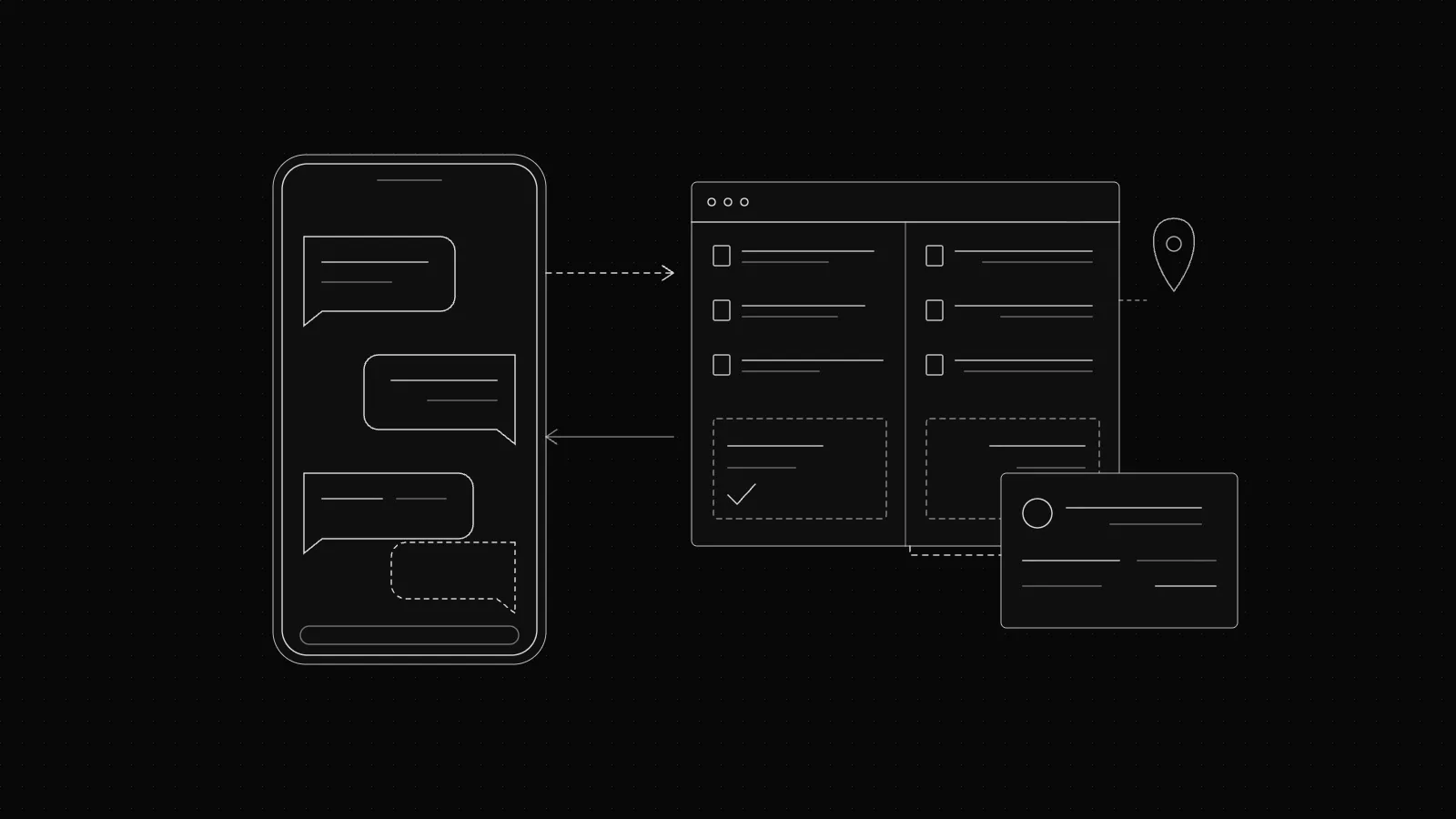
An Arabic and English AI chatbot for a UAE business has to read Gulf Arabic, Modern Standard Arabic, English and Arabic typed in Latin letters, and answer in the language the customer used. It answers from a reviewed bilingual FAQ bank, never with improvised prices, and runs on WhatsApp before a website widget. Builds start at 15,000 AED.
Below we cover what makes the bot work for UAE customers, the test cases we run before launch, how the two languages change templates and CRM data, and what bilingual support adds to the cost.
Which Arabic does a UAE chatbot need to understand?
It needs four kinds of input: Gulf Arabic, Modern Standard Arabic (MSA), English, and Arabizi. Customers rarely pick one. A single clinic or brokerage gets all four in the same week, often from the same person.
Gulf Arabic is how most UAE residents type: "أبي أحجز موعد باجر". MSA turns up in formal messages, complaints and anything copied from a document. Arabizi is Arabic written in Latin letters, with numbers standing in for sounds that have no Latin match. A 3 is the letter ع, a 7 is ح. "Abi a7jez maw3ed bukra" means the same as the Arabic sentence above, and many models handle it worse than either clean Arabic or clean English.
Models trained mostly on MSA and English read everyday chat Arabic well enough. They fail on dialect words, Arabizi spellings, names and numbers. We cover where and why in our bilingual app article. For a chatbot the fix is the same: test on your own customers' messages, not on a benchmark.
Can the bot switch language in the middle of a chat?
Yes, and it should follow the customer without asking. A customer who starts in English and drops into Arabic for the price question expects the next reply in Arabic. A bot that asks "Please choose a language" at message three has lost them.
Our rule is to reply in the language of the customer's last message, keep names and addresses as typed, and never translate a number or a unit. Mixed messages such as "abi 2 bedroom fi JVC" get the reply in the dominant language of the sentence, with the English terms kept as the customer wrote them.
The bot also needs a way to be told. If someone writes "English please" or "بالعربي", that overrides detection for the rest of the chat. Store the preference on the contact so the next conversation starts in the right language.
What does a bilingual test table look like?
It is a list of real customer messages, each with the language or dialect we expect and the exact behavior required. We run it before launch and again after every change to the prompt or the FAQ bank. The cases below are a starter set for a clinic or a service business. Replace them with messages from your own inbox.
| Customer message | Language / dialect | What the bot must do |
|---|---|---|
| "أبي أحجز موعد باجر" | Gulf Arabic | Reply in Arabic, offer real slots for tomorrow, confirm date and time back |
| "Abi a7jez maw3ed bukra" | Arabizi | Treat as Gulf Arabic, reply in Arabic script or Arabizi to match, same booking flow |
| "كم سعر الكشف؟" | MSA / light Gulf | Answer from the approved price entry only. If none exists, say so and route to staff |
| "What time do you close on Friday?" | English | Answer from the hours entry, in English, with Friday hours not weekday hours |
| "Hi, ممكن أحجز for Sunday?" | Mixed | Reply in the dominant language, keep "Sunday" as typed, offer Sunday slots |
| "English please" after three Arabic messages | Language override | Switch to English now, store the preference on the contact |
| "ابي اكلم موظف" | Gulf Arabic, handoff request | Hand off at once, with the chat summary, in Arabic. No more questions |
| "My name is محمد العلي" | Mixed script name | Save the name as typed, and keep a Latin spelling field for the CRM |
| "٣٠٠ درهم؟" (Arabic-Indic digits) | Arabic with Eastern digits | Read it as 300 AED, never as another number, repeat the figure back |
| A voice note in Gulf Arabic | Audio | Transcribe only if confidence is high. Otherwise ask for text or hand off |
A case passes only if a native speaker reads the reply and calls it natural. A reply that is grammatically right and sounds like a translated brochure counts as a fail.
In the bilingual chats we test, the dialect is rarely what breaks the bot. Names and numbers do: a Latin spelling that does not match the Arabic one, or a price read from the wrong digit set. We put those two cases first in every test table.
Do WhatsApp templates need to be approved in both languages?
Yes. Each language is a separate template. Meta lets you create several templates with the same name in different languages (Meta: template fundamentals). You choose a language code on creation, and Meta does not translate the text or the variables for you. Arabic (UAE) has its own code, ar_AE, next to plain ar (Meta: supported languages).
In practice this means one booking confirmation, two approvals. Each variant is reviewed on its own, so a rejection of the Arabic version does not block the English one. Submit both on day one. Our template approval timeline article shows how long review takes and what gets rejected.
Templates only matter outside the 24-hour window. Inside it, the bot replies free-form, and the language follows the customer, as described above. Outside it, the bot must pick the right template variant, so the contact's stored language decides which one is sent.
Two checks before launch. First, send each Arabic template to a real phone and read it. Mixed-direction text, such as an Arabic sentence with an English name or a number in the middle, can display in an order that looks wrong, and only a native reader will notice. Second, check the price category on delivery. A language variant is billed like its English twin, at the rates in our WhatsApp Business API cost guide. That is 0.0576 AED for a utility template and 0.2115 AED for a marketing one to a +971 number. The customer receives one message, so bilingual does not double the Meta bill.
How do you stop a bilingual bot from inventing prices?
You answer from a reviewed bilingual FAQ bank and nothing else. Every price, opening hour, policy and address lives as an entry with an Arabic version and an English version, both written or checked by staff. The model finds the right entry and phrases the reply. It does not produce the fact.
Each entry carries an owner and a review date. When the price changes, both versions change together. If the customer asks something outside the bank, the bot says it will check and routes to a person (our handoff article covers the triggers).
This matters more in Arabic. A customer reading a wrong price in their own language assumes it is the business's price, and a confident wrong answer in dialect is harder to spot internally than one in English. If nobody on your team reads Arabic well enough to review the bank, hire a reviewer before you build. The same rule applies to voice, and our Arabic-English voice agent article explains why we keep voice behind a text-first launch.
How should the CRM store Arabic and English names and addresses?
Store both scripts as separate fields and never overwrite one with the other. A contact record should hold the name as the customer wrote it, an Arabic spelling and a Latin spelling, plus the preferred language. Addresses work the same way, with the Arabic building name next to the Latin one, with the area as a fixed value from your own list.
The reason is matching. "Mohammed Al Ali", "Mohamed Alali" and "محمد العلي" are one person, and a bot or an agent searching for any of them has to find the record. Without paired fields you get duplicate contacts, and the second conversation starts from zero. Chat logs and CRM records with names and phone numbers are personal data under the UAE PDPL (Federal Decree-Law No. 45 of 2021), so decide retention before launch. Our PDPL-compliant AI CRM guide covers the data flow.
Should the chatbot run on WhatsApp or on the website?
WhatsApp first, the website widget second. Customers in our UAE builds already message businesses on WhatsApp, the thread stays on their phone, and the number is already on your listings and your Google profile. A widget shares the same FAQ bank and the same test table, so adding it later is cheap. Starting with a widget and adding WhatsApp afterwards usually means redoing the language handling.
On WhatsApp the bot must follow Meta's rules: opt-in before you message first, and a clear route to a person when automation is on (WhatsApp Business Messaging Policy). Our WhatsApp automation service page lists what we build on the official platform.
How much does bilingual support add to a chatbot's cost?
A focused WhatsApp build runs 15,000 to 40,000 AED, with the bilingual work inside that range when it is planned from the start. Running cost is roughly 500 to 5,000 AED a month for model and API spend, plus Meta per-message fees and a BSP fee (AI maintenance costs). We do not quote a flat bilingual surcharge for chatbots, because the extra depends on a few drivers:
- Reviewed content. Two versions of every FAQ entry, each checked by a native speaker.
- Template count. Every template is submitted once per language.
- Test set size. More cases per language, plus Arabizi and mixed-script messages.
- Dialect and voice. Text-only is the lower end. Voice notes and calls need dialect audio data and add work.
- CRM changes. Paired name and address fields, and migration if your records are in one script only.
The cheapest route is to build both languages from day one. Adding Arabic to an English bot later means reopening the FAQ bank, the templates and the CRM fields. We priced the full range in our WhatsApp chatbot cost article. For a live example, the property-management platform handles about 60% of tenant chats with AI and sends the other 40% to a person.
The takeaway
A bilingual chatbot works when it reads four kinds of Arabic and English input, follows the customer between languages, answers only from a reviewed bank in both languages, and stores names in both scripts. Test it with native speakers on a table of real messages, get templates approved per language, and launch on WhatsApp before the website.
Tell us about the workflow and we'll come back with a fixed-price estimate the same day.
Questions people ask
Can an AI chatbot understand Gulf Arabic?
Yes for typed chat, with limits. Most models read everyday Gulf Arabic well enough, but they fail more on dialect words, names and numbers than on English. Test the bot on a few hundred real messages from your customers and score names, numbers and dialect separately before launch
What is Arabizi and can a chatbot read it?
Arabizi is Arabic typed in Latin letters, with numbers for some sounds, such as 3 for ع and 7 for ح. A chatbot can read it if it is tested on it. Add real Arabizi messages to your test set, because many models handle it worse than clean Arabic or English
Do I need separate WhatsApp templates for Arabic and English?
Yes. Each language is its own template with its own language code, such as ar_AE for Arabic (UAE), and each is reviewed by Meta separately. Meta does not translate your text or variables, so submit both versions together on day one
Can a chatbot reply in the language the customer uses?
Yes. The bot answers in the language of the customer's last message, follows a switch mid-chat, and keeps names and numbers as typed. A customer can override it with a message like English please, and the preference is stored on the contact for the next conversation
How do I stop a chatbot from quoting wrong prices in Arabic?
Answer only from a reviewed bilingual FAQ bank. Each price, hour and policy has an Arabic and an English entry, checked by staff, with an owner and a review date. If a question is outside the bank, the bot routes to a person instead of guessing
How much does an Arabic and English WhatsApp chatbot cost in the UAE?
A focused WhatsApp build runs 15,000 to 40,000 AED, plus roughly 500 to 5,000 AED a month in running costs and Meta fees. Bilingual support adds reviewed content, templates per language, a larger test set and CRM fields, priced after a call
Sources
- Meta: template fundamentalsdevelopers.facebook.com
- Meta: supported languagesdevelopers.facebook.com
- Federal Decree-Law No. 45 of 2021uaelegislation.gov.ae
- WhatsApp Business Messaging Policybusiness.whatsapp.com
 ChatGPT
 Gemini
 Claude
 Perplexity
 Google AI
 Grok