
This case shows how a real estate agency put AI agents into its back office: document filling, CRM review and a chat-edited CRM. A document that took 30 minutes now takes 5 to 7, and costs about $0.20 (≈0.73 AED, converted) in model tokens. Under 2% of fields need a correction, and 95% of leads in the CRM carry the right status. PHII Labs built a custom CRM with a document admin agent, a lead-review agent and manager analytics, all run by a multi-agent pipeline with checks against made-up data.
Context
The agency handled a large stock of units in specific buildings. Every deal meant forms, contracts and dates. Every lead meant a long chat history that someone had to read before they could pick it up.
Managers needed to know how the team handled leads, and the answer sat inside the dialogues.
Problem
- Documents were slow. One document took 30 minutes of staff time
- Lead quality was invisible. Nobody could see how staff answered incoming leads, or where deals were lost
- The CRM was a chore. Statuses were forgotten, handovers lost context, and files lived apart from the lead or property they belonged to
What was built
- Document admin agent. It fills in forms day and night. It also checks extra fields and dates in the documents before a person signs off
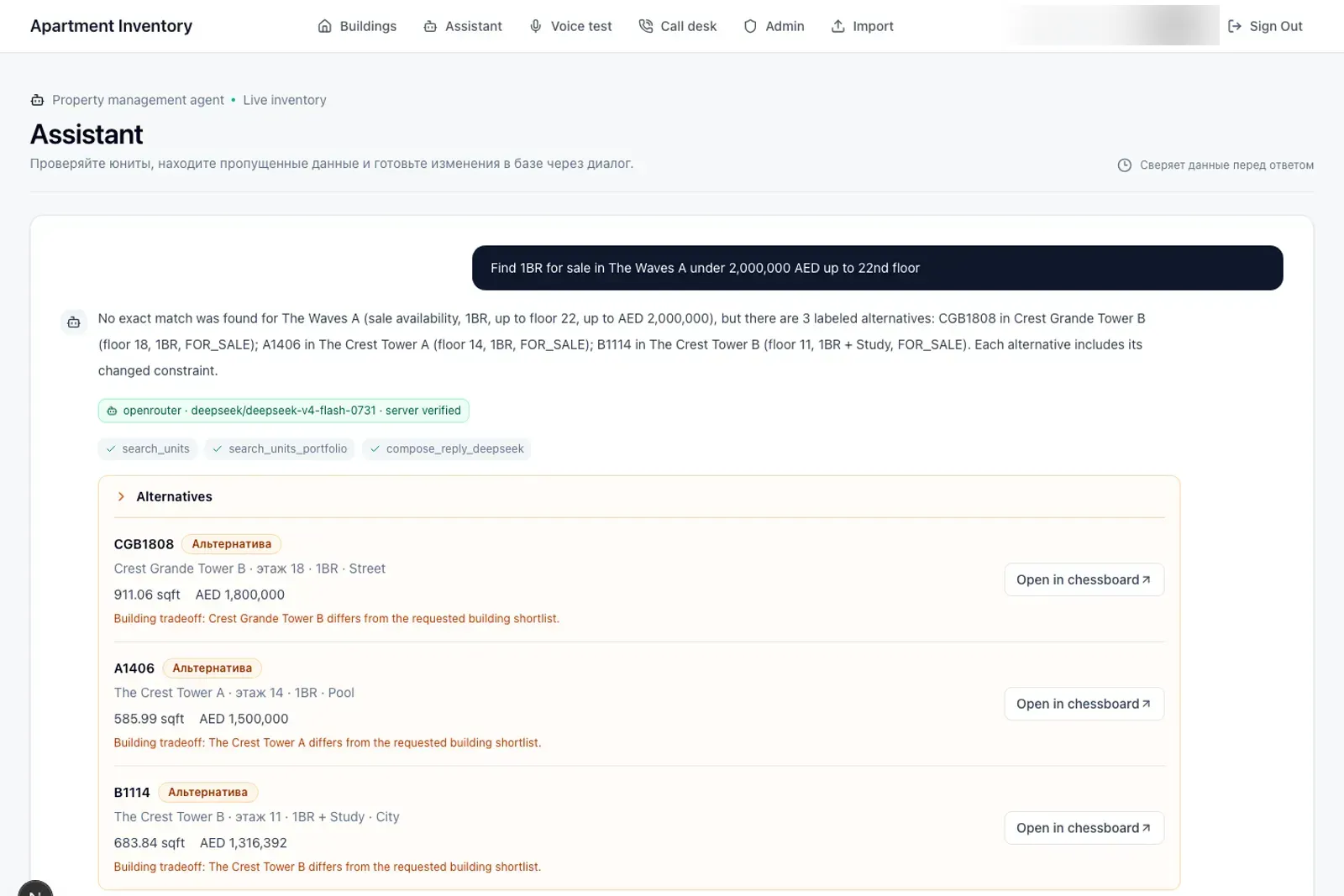
- CRM analyst agent. It reviews how staff answer incoming leads and where they did not close. It summarises the history of an old lead or a lead handover, so the next person starts with context
- Weekly team report. It shows what to improve, who stood out and who forgets to set statuses. It is built on CRM data
- Custom CRM with chat and voice editing. Lead and property cards can be changed by chat or by voice. The agent asks for all required fields and updates the right card
- Audit trail. The CRM shows who changed what, how and when
- Cloud file storage. Files are linked to a lead or property and can be pulled quickly through the chat
- Manager analytics. Summaries and cohort analysis come from the embedded agent
- Multi-agent pipeline with checks. Every answer is checked, so the system does not output data that does not exist
- Simple UX/UI. The interface is built for a large stock of units in specific buildings
Results
- Time per document: 30 min → 5 to 7 min
- Under 2% of fields need a correction after the agent
- Correct lead statuses in the CRM: 95%. In the first days the agent reminded staff daily about missing statuses
- Cost per document: about $0.20 in tokens (≈0.73 AED at the 3.6725 peg, converted)
- Forms are filled day and night, with fields and dates checked
- Managers get a weekly view of team performance, including missed statuses
- Leads can be handed over with a short summary instead of a full re-read
Takeaway
In a real estate back office, most of the cost is routine: forms, statuses, and reading old chats. Agents handle that well when they work inside one CRM with clear fields and a visible change log. The checks matter as much as the model. They keep the agents from inventing data, and the audit trail shows a person who changed what.
For the wider picture, see our AI real estate systems service. For the document side in detail, read Dubai real estate document automation.
Further reading
PDPL-compliant AI CRM in the UAE: data flows that pass audit

 ChatGPT
 Gemini
 Claude
 Perplexity
 Google AI
 Grok