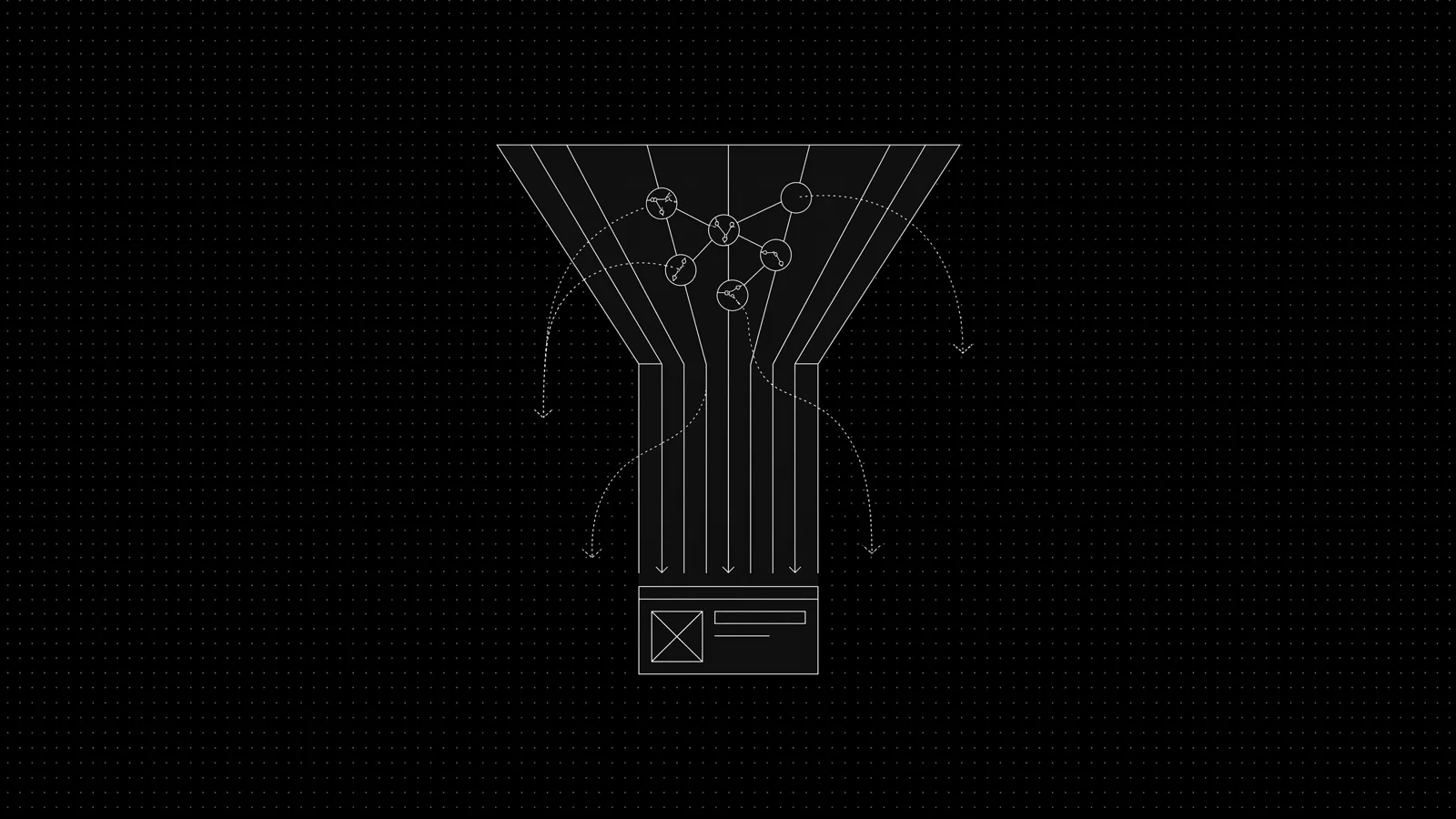
Most AI citations do not show up as clean referrers. Perplexity and ChatGPT browsing send identifiable visitors, but copy-paste and app traffic land as direct, and a UTM parameter you never controlled does not exist. The honest way to measure whether an AI answer turns into pipeline is to stack several imperfect signals and read them together
The gap between what a GEO agency shows you (a screenshot of a citation) and what your CRM finally books (a signed deal) is where most AI-search effort dies without a trace. Attribution for generative engines is not one metric. It is a stack of weak signals, and each one lies in a predictable direction. Below is how we measure it for clients in Dubai and on our own site, and which signals we refuse to over-read
Do AI assistants send referral traffic you can measure?
Part of it, yes. Perplexity sends visitors from perplexity.ai as a referrer when a user clicks a cited link inside the answer. ChatGPT does the same from chatgpt.com when browsing mode is on. Those show up in your analytics as medium referral with a source you can filter for. Google Search Console also surfaces AI Overview and AI Mode appearances in the regular Performance report under the Web search type, per Google's documentation on AI features.
The rest does not. When a user copies your URL out of an answer and pastes it into a fresh tab, or reads the answer inside the mobile app where links are not followed, they arrive as direct traffic. AI assistants that use your domain as a bare named source without a link behave the same way. Treat referrer data as a floor, never the total. If perplexity.ai shows 20 visits this month, the true AI-driven number is higher, and you cannot know by how much from referrers alone
How do I track leads that actually came from AI answers?
Stack three signals and read the overlap, because no single one is complete
The first is the referrer layer above: filter analytics for chatgpt.com, perplexity.ai, and Gemini's surfaces. It catches the click-through portion and it is easy, so start there
The second is self-reported attribution. Add an optional "How did you hear about us" field to your intake and booking forms, with an AI-search option in the list. In Dubai this matters more than in most markets, because a large share of buyer research happens on WhatsApp and on the phone after the site visit, and referral data never survives that handoff. The form is the one place you can attach a reason to a contact that arrived as direct
The third is branded-search lift. People who read an AI answer rarely bookmark your site; they search your name later, often from a phone. So a rise in branded queries in Search Console, or in branded organic clicks, is a leading indicator that AI exposure is converting into recall. a mindshare analyzer we built, a tool we built to track how often a project's leaders are mentioned across the web, runs on the same logic: unprompted mentions and searches are the lagging proof that exposure turned into memory
None of these is the whole picture, which is why we refuse to report a single "AI attribution" number to a client. We report the three signals in a table each month and let the shape of the data tell the story
Is there a UTM parameter for AI citations?
No, and chasing one wastes weeks. An AI engine cites your URL as it read it from your site or a third party. It does not append ?utm_source=chatgpt the way a newsletter or an ad click does. Even where you control canonical URLs, the engines rewrite your question into their own queries and pull the page that best matches; they are not configured to honor your campaign parameters
The practical substitute is dedicated landing content, not UTMs. If you expect to be cited for "how much does AI automation cost in Dubai", that page should carry a booking form and a phone number directly under the price table, because that is the page the engine will send people to. We do this on our service pages and our cost articles. The citation itself is unwritable, but the page that receives the click is yours to design
Note
A "How did you hear about us" field recovers attribution that no analytics package can see, because it attaches a stated reason to a contact that arrived as direct. Keep it optional and short. A required field on a high-intent booking form costs you conversions for data you mostly do not need that precisely. And when the field stores contact details from UAE residents, keep it inside the same PDPL data-flow (Federal Decree-Law 45/2021) as the rest of your CRM, with documented retention and deletion paths.
What does a working AI-attribution stack look like?
Here is the tracking stack we run behind the scenes for a client that wants to know whether a Perplexity citation produced pipeline. It is the original artifact of this article, and you can copy the structure and substitute your own analytics, CRM and form tools
| Signal | What it captures | What it misses |
|---|---|---|
Referrer filter for chatgpt.com, perplexity.ai, gemini.google.com | Click-through visits from a cited link | Copy-paste, app-internal reading, visits after a middleman search |
| Self-reported "How did you hear" field on booking forms | Stated source, survives WhatsApp and phone handoff | Every visitor who skips the optional field, and any bias in what people recall |
| Branded-search lift in Search Console | Recall and later direct intent from AI exposure | Anything that never reaches a search engine |
| Server-log crawler hits (GPTBot, ClaudeBot, PerplexityBot) | Whether the changed page was fetched at all | The human visit that follows, which only analytics can count |
| Booked-call UTM tag on the final CTA | The one click you fully control, the appointment itself | The attribution trail before that click |
| Fixed prompt-set citation log | Which of your pages get cited, when, on which engine | Whether a citation ever became a visit; the two are unlinked in any one tool |
The last row matters because it is the only one that connects visibility to pipeline. We keep a table of run date, engine, prompt, position, and cited domain, exactly as described in the measurement section of our citation guide. Then we join it to the analytics referrers and the CRM bookings on a monthly schedule. A page that gets cited at position one but never appears in the referrer filter is an exposure that did not convert; a page that gets cited and produces booked calls is the whole loop working
The join is where most teams stop. It is easy to run citations one month and check bookings three months later and see nothing, because the two datasets were never connected. We match on URL path, not just domain. If perplexity.ai sent 12 visits to /blog/ai-search-attribution this month, and your form on the same page produced two booked calls, you have a measurable conversion rate for that citation. That is the number to grow
How long until a citation shows up in your pipeline?
There is a lag, and it is longer than most people expect. A page you optimize today gets crawled somewhere between days and weeks, indexed, then surfaced the first time an engine answers a matching prompt. That first citation is not repeatable Monday to Monday; it varies by run, and one lucky answer proves nothing. We run each prompt three times per engine per date and only count a citation as stable if it appears in at least two of three runs, a method covered in our GEO mechanics guide
Once citations are stable, the pipeline effect lags further. A buyer reads the answer, visits the page, goes away, searches your brand later, and books a call days or weeks after. So plan on a quarter, not a week. Track monthly, and judge the trend over three monthly snapshots rather than reacting to a single spike or dip
For a Dubai real estate operator the pattern in our lead qualification guide is the same: a Property Finder or Bayut portal lead and an AI-referred lead both need hours of follow-up before they decide, and attribution you measure on day one is noise. Give the funnel a full quarter and it starts to read clearly
Which AI engines are worth attributing first?
Not all engines send the same quality or quantity of traffic, and we measure them separately rather than lumping them into "AI traffic". Perplexity is the most referral-transparent of the engines, which makes it the easiest to attribute, but its user base is smaller. ChatGPT has the largest reach by far, yet browsing-mode clicks are a small share of how people use it, so your referrer filter undercounts it the most. Gemini sits in the middle and mostly reaches people already inside Google's properties
Normalize for effort: a page that ranks for a high-intent query like "how much does AI automation cost in Dubai in AED" is worth far more attribution work than one cited for a definitional prompt with no buying intent. Cost queries, pricing tables, comparison pages and "how long does X take" pages are where AI citations turn into booked calls. Definitional answers collect empty traffic
In one property-management platform we built, about 60% of tenant chats finish on the bot now that the intake rules are tuned. The lesson transfers to AI search: a citation that hits a passive brochure page converts to nothing, while a citation that lands on a page with a booking form and a phone number converts into measurable pipeline. We track both page types and the conversion gap between them is real
How do you keep the measurement honest?
The temptation is to claim every lift as AI attribution, and the discipline is to label the direction of each bias. Referrers undercount, so that signal is a floor. Self-reported forms are biased by memory, so read them as directional, not exact. Branded-search lift is contaminated by offline word of mouth, which is almost impossible to separate. The honest output is a table with the three numbers side by side and a note about what each might be hiding, as our AI-search visibility audit checklist lays out
We also stop people from over-reading a single metric. An agency that shows you a screenshot of a citation and claims credit for your bookings is skipping the join entirely. Ask for their per-URL conversion data, not their citation count. A citation with zero referrers and zero bookings is a vanity number. A citation that produces a booked call on its own landing page is a channel you can scale
The one number that survives scrutiny is booked calls per cited page per month, because it is grounded in your own CRM and your own analytics rather than in an engine's willingness to link you. Everything before it is a leading indicator with a bias you need to name
The takeaway
AI-search attribution is a stack of biased signals, not a single dashboard metric. Collect AI referrers as a floor, add a self-reported source field on forms, watch branded-search lift, and join the citation log to booked calls by URL. Judge the trend over a quarter. A citation that lands on a booking-ready page and produces a call is the only number worth growing
Book the free audit. We run your top buyer questions across ChatGPT, Perplexity, Gemini and AI Overviews, send you the citation log, and attach the per-URL conversion view so you can see the gap between visibility and pipeline for yourself
FAQ
Do AI assistants send referral traffic you can measure?
Partially — Perplexity and ChatGPT browsing send identifiable referrers, but copy-paste and app traffic arrive as direct. Treat referrer data as a floor, not the total
How do I track leads that came from AI answers?
Combine three signals: AI referrers in analytics, a 'how did you hear about us' field on intake, and branded-search lift. No single signal is complete alone
Is there a UTM parameter for AI citations?
No — AI answers cite your URL without parameters you control. Use dedicated landing content and self-reported attribution on forms instead of chasing UTMs
How long until AI citations affect pipeline?
Citations appear in weeks once pages get indexed by the engines; measurable pipeline contribution typically shows over a quarter. Track monthly against a fixed prompt set
Sources
- Google's documentation on AI featuresdevelopers.google.com
- Federal Decree-Law 45/2021uaelegislation.gov.ae