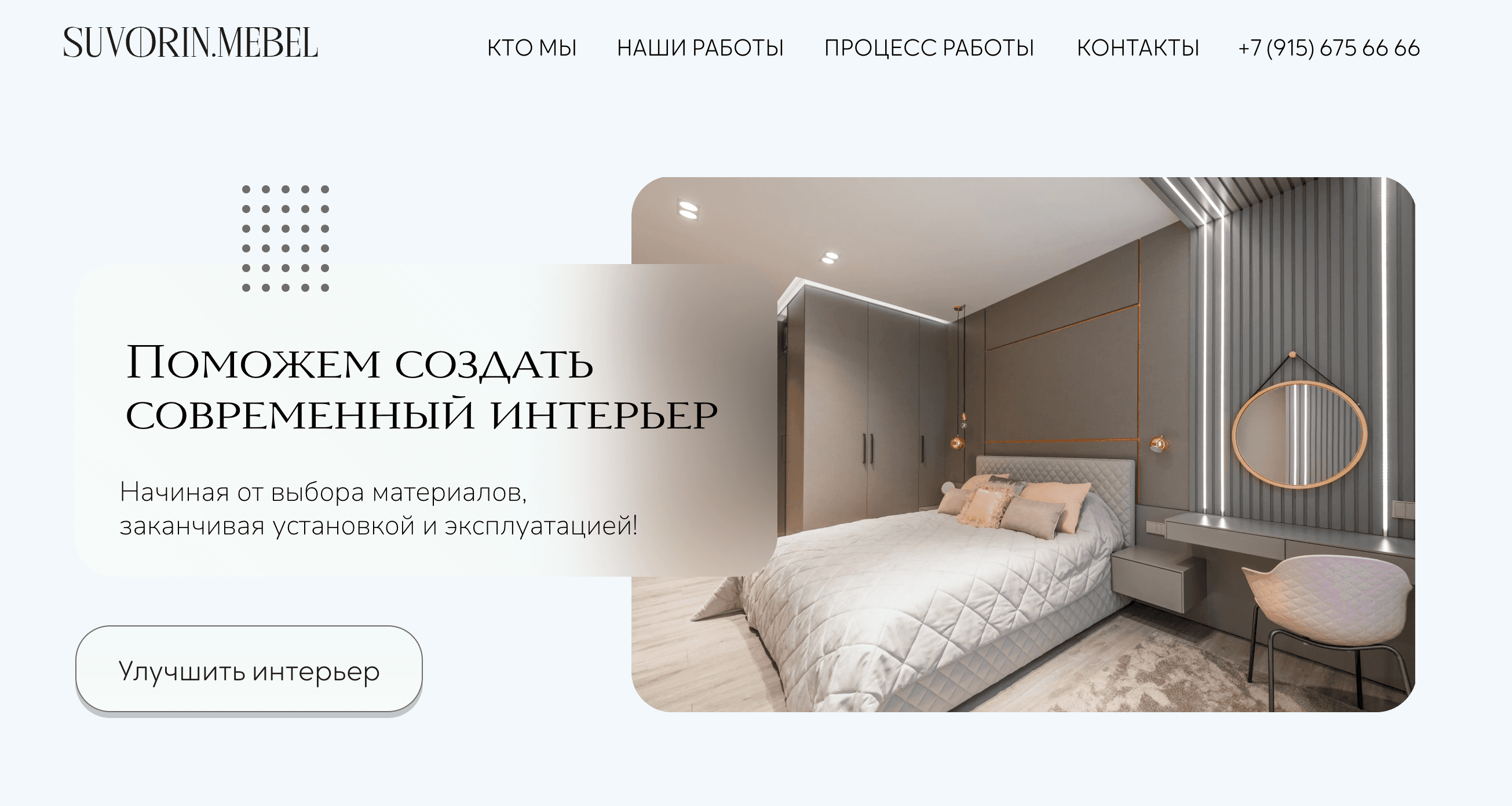
Custom furniture has a visualization problem. A client describes what they want — a sectional sofa in a specific fabric, with particular dimensions, for a room they can picture but can't easily share — and the seller has to turn those words into a mental image and hope the final product matches. A furniture e-commerce, a custom furniture studio, came to us in 2023 because that translation step was costing them deals
Context
A furniture e-commerce runs a Tilda-based storefront with Notion as the content management layer. Product catalogs, fabric options and pricing lived in Notion and synced to the frontend. Payments ran through Stripe. The business is made-to-order: every piece is built to a client's specification, so every sale needs the client to picture the result with confidence before committing
Problem
The bottleneck was the mockup. When a client submitted a brief — dimensions, fabric, style references — a designer had to produce a visualization by hand. That took hours, sometimes days, and in that window leads went cold. Clients who couldn't see the product hesitated, second-guessed, or went to a competitor who could show them something faster
The team had tried stock photos and fabric swatches. Neither solved the core issue: the client wanted to see their own configuration, not a generic example. Manual rendering didn't scale, and hiring more designers wasn't justified by the conversion lift
Approach
We built a text-to-render pipeline using Stable Diffusion. When a client fills out a configuration brief on the Tilda site, the brief goes to a generation service that renders a preview of the described furniture in a neutral interior. The model is conditioned on furniture-specific prompts — sofa types, wood finishes, fabric textures — so the output reads as a product visualization, not a generic AI image
The client gets the generated mockup within minutes, attached to their configuration and dropped into a Stripe checkout flow. If they want changes, they adjust the brief and regenerate. Notion CMS tracks the configuration and its mockup, so when the order comes through, the production team has a visual reference next to the spec
The key design choice was speed over perfection. The mockups aren't photorealistic product photography. They're close enough to let the client say "yes, that is what I want" or "no, make it darker." That decision — not "is this render beautiful" — is what the mockup exists to support
What was built
- A Tilda storefront with a configuration form capturing dimensions, fabric, and style preferences
- A Stable Diffusion generation service conditioned on furniture-specific prompts, producing rendered previews from text briefs
- A Notion CMS integration that links each configuration to its generated mockup and routes the spec to the production team
- A Stripe checkout flow attached directly to the approved configuration, so the client can commit without leaving the page
Results
In the first month after launch:
- Lead-to-order conversion up 7%. Clients who saw their configuration rendered were more likely to commit
- 120+ mockups generated in the first month alone — volume that would have taken a full-time designer to match by hand
- Average response time to a brief cut to 5 minutes. What used to take hours of designer time now takes as long as the model needs to run
The conversion lift was real, but the operational shift mattered more. The design team stopped being a bottleneck. Mockups that used to queue behind a designer's workload now generate on demand, and the team can focus on the orders that actually close
Takeaway
Generative image models are most useful in e-commerce when they replace a manual step that doesn't scale. A furniture e-commerce didn't need better images — they needed faster ones, produced at the pace of their lead flow and tied directly to checkout. Stable Diffusion conditioned on product-specific prompts does that. The mockup isn't the product. It's a decision tool that gets the client to yes, and getting to yes faster is what closes custom-order sales

 ChatGPT
 Gemini
 Claude
 Perplexity
 Google AI
 Grok