An AI proof of concept in Dubai runs AED 15,000 to 50,000 and takes two to four weeks. A real MVP with actual users runs AED 60,000 to 200,000 and takes six to twelve weeks. A product-grade first release starts around AED 200,000. Those ranges come from what we and our peers actually quote and ship in the UAE, and the spread inside each band is driven by three things: integrations, bilingual requirements, and the state of your data
Here is the honest breakdown by scope, including the costs vendors leave off the slide
What do the three stages actually buy you?
The words get used loosely, so first the definitions we work with:
| Stage | Cost (AED) | Timeline | What it proves | What it deliberately skips |
|---|---|---|---|---|
| POC | 15,000–50,000 | 2–4 weeks | The model can do the core task on your real data | UI, auth, production infra, edge cases |
| MVP | 60,000–200,000 | 6–12 weeks | Real users get real value without manual rescue | Scale, polish, full admin, billing |
| Product v1 | 200,000+ | 3–6 months | Customers can pay and rely on it | The remaining 80% of the roadmap |
A POC answers exactly one question: can the model do the core job reliably on real inputs? If the core task fails, you learned it for AED 20k instead of AED 200k. That is the whole point of the stage
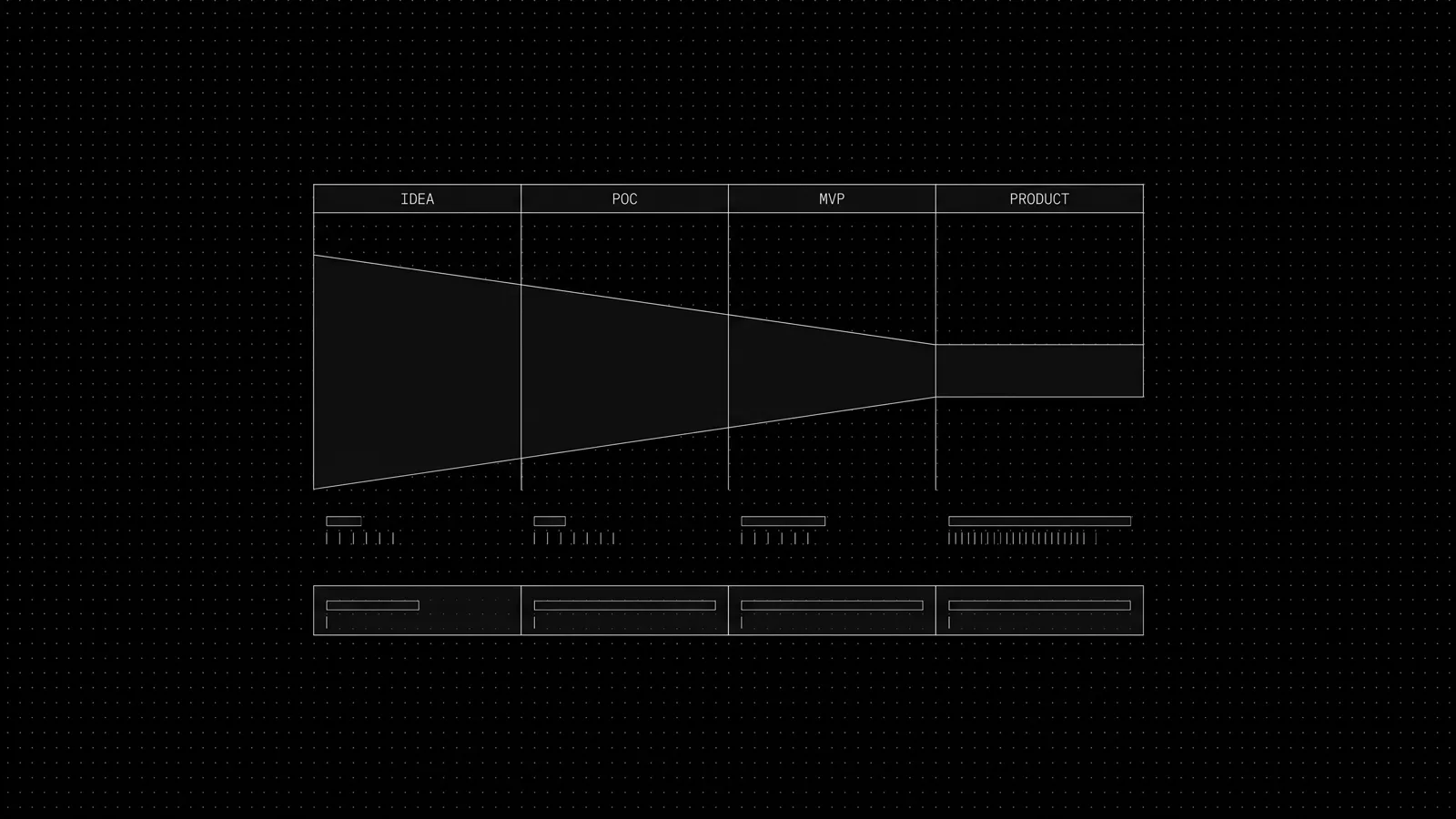
Each stage exists to kill a different class of uncertainty
What drives the spread inside each band?
Three variables move a quote more than the model choice ever does
Integrations. Every external system the product must talk to adds a workstream: a clean REST API costs days, a legacy system with no API or a vendor that answers emails in weeks costs much more. One undocumented ERP can cost more than the entire AI layer
Bilingual scope. Arabic + English support is not "translate the UI." Voice notes in Khaleeji, RTL layouts, Arabic document OCR and mixed-script search each add real engineering and evaluation time
Data readiness. The cheapest projects arrive with clean data the client can export. The expensive ones arrive with data in PDFs, WhatsApp threads and someone's memory, and somebody has to turn that into a dataset before the model sees it. This is the line item clients most often forget to budget
What are the run costs nobody quotes?
The build cost is only the first number. Monthly run cost for a Dubai-scale AI product typically looks like:
| Line | Typical monthly (AED) | Notes |
|---|---|---|
| Model/API usage | 200–5,000+ | Scales with volume; a chatbot at low traffic is cheap, document processing is not |
| Hosting + storage | 300–2,000 | UAE-region or EU-region, depending on residency needs |
| Monitoring + on-call retainer | 1,500–8,000 | Prompt updates, template maintenance, upstream API changes |
| Third-party licences | variable | CRM seats, BSP fees, OCR volumes |
Maintenance lands at roughly 10–20% of build cost per year for prompt and model drift, integration changes and monitoring. A vendor who quotes only the build is quoting you half the bill
What should you NOT cut to save money?
The temptation is to cut the evaluation set, the fallback path, and the "boring" write-back integration. All three are the product. An AI feature that works 90% of the time with no fallback is a demo; the last 10% is where the engineering money goes and where user trust is won or lost
The correct cuts are different: fewer surfaces (one channel, not three), fewer integrations at launch, narrower persona scope, and manual operations behind a thin UI where volume does not yet justify automation. Cut breadth, never reliability on the one core task
What does a real scope example look like?
A Dubai brokerage MVP we would quote today: a WhatsApp intake bot that qualifies portal leads, writes them to the CRM, and flags hot ones to an agent — the pattern from the portal leads article. At POC scope (one portal source, one language, no handoff) that is a ~3-week, ~AED 30–45k job that proves the extraction works on real enquiries. At MVP scope (both portals, AR+EN, CRM write-back, human handoff) it is a 6–9-week, AED 90–160k job. At product scope (multi-branch reporting, template approval workflows, Arabic voice notes) it is AED 200k+. The spread is the bilingual work and the CRM integration, not the model
Where does the money go inside an MVP?
Roughly: discovery and field-map agreement ~15%, extraction/qualification logic ~30%, integrations (CRM, WhatsApp, inventory) ~25%, edge cases and evaluation ~20%, admin/monitoring ~10%. The pattern repeats across project types: integrations and edge cases together are the larger half, which is why a proposal that puts 80% of the budget into "the AI" is mispriced
We have shipped the same WhatsApp intake pattern at AED 90,000 and at AED 160,000. The spread was always bilingual scope and CRM integration work; the AI was the same, the evaluation set was the same, and the failure modes were the same.
When do the numbers break these ranges?
Two cases blow past the top of every band. First, regulated or compliance-adjacent work — document pipelines that must survive a PDPL audit add a review cycle, a retention design and an audit log that a simple chatbot never needs. Second, anything that touches a system the vendor does not control and cannot inspect — a closed ERP, a government portal, a partner's queue — because the discovery cost is unknown until someone actually tries to integrate it. Both cases are why the honest proposal shows a range and a discovery phase, not a single price
Agency, freelancer or in-house for the first build?
For a startup validating an idea, hiring in-house before product-market fit is the most expensive option: two senior developers in Dubai cost AED 40,000+ monthly in salary alone, which buys a full agency MVP. A senior freelancer works for bounded scope with your own technical reviewer; without one, you cannot evaluate what you are buying. The full comparison — including when each option is genuinely right — is in AI agency vs freelancer vs in-house, and the operational-side pricing lives in what AI automation costs in Dubai
The takeaway
Budget in stages: 15–50k to prove the core task works, 60–200k to put it in front of real users, 200k+ for a product. The spread is integrations, bilingual scope and data readiness, not the model. Cut breadth before reliability, and plan run costs of 10–20% of build per year plus usage from day one
FAQ
How much does an AI MVP cost in Dubai?
A proof of concept runs AED 15,000–50,000, a real MVP AED 60,000–200,000, and a product-grade first release AED 200,000+. The spread is driven by integrations, bilingual requirements and data readiness more than by the model itself
How long does it take to build an AI MVP in Dubai?
Two to four weeks for a POC, six to twelve weeks for an MVP with real users. Anything promising a production AI product in under a month is describing a demo
What is the cheapest way to validate an AI idea?
A POC on real data with a fixed success metric — not a polished UI. Validate that the model can do the core task reliably before paying for anything else
How much does AI app maintenance cost?
Budget 10–20% of build cost per year for prompt and model updates, monitoring, and integration maintenance, plus model/API usage which scales with volume
Should a startup build in-house or with an agency?
Validate with an agency or senior freelancer first — hiring two developers before product-market fit costs AED 40,000+ monthly in salaries alone, which buys a full MVP from an agency